
Air conditioning repair, explained
What an air conditioning service call covers, which problems are common, what you can check first, and how to tell a repair from a replacement conversation.
By Elijah Canfield, Founder, Hire Best Pros · Updated September 9, 2026
Elijah Canfield is the founder of Hire Best Pros. He writes and edits the site's consumer guides, with a focus on how home service and moving projects are priced, scoped and compared.
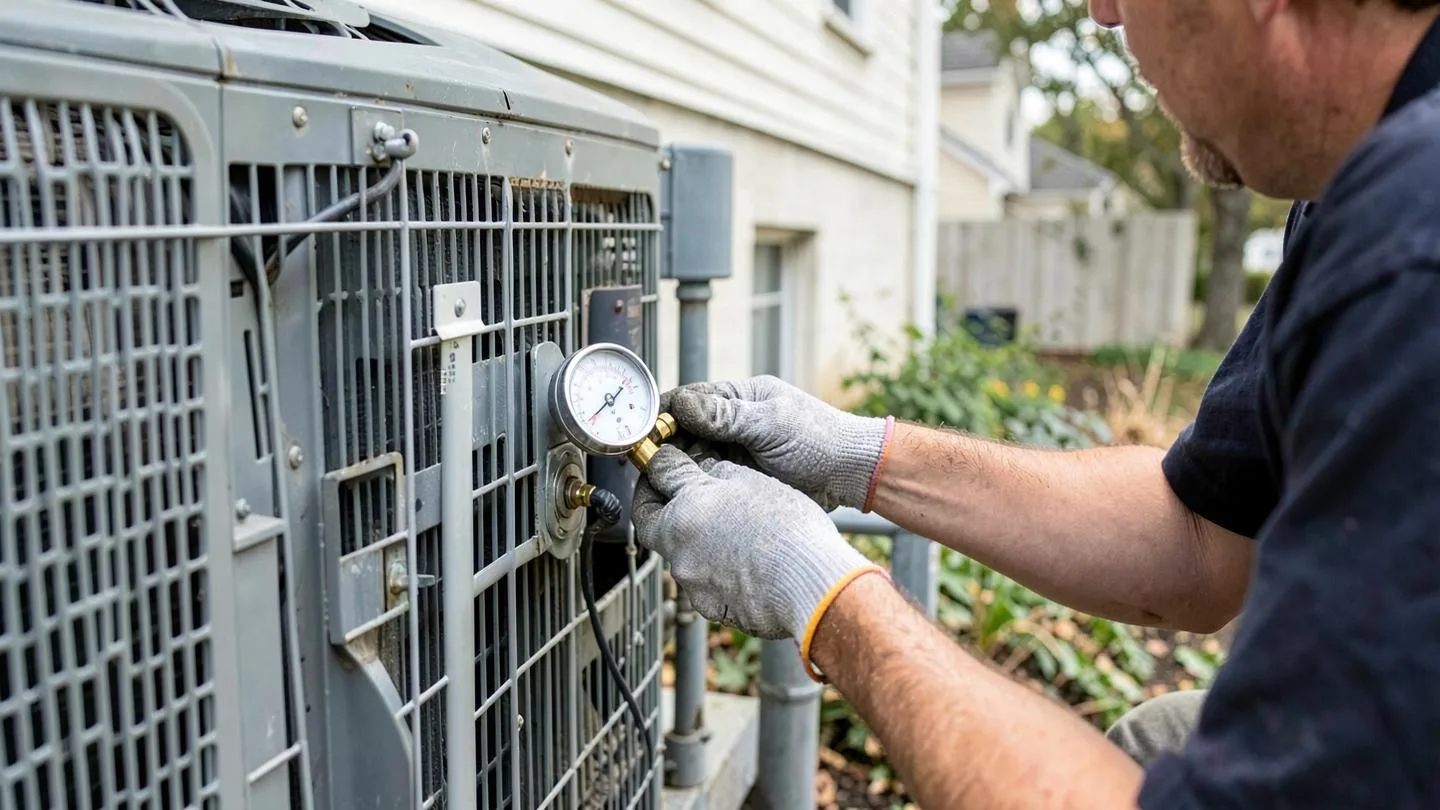
Most air conditioning service calls start with a diagnostic visit: the technician checks airflow, refrigerant pressures, the electrical components and the drain, then reports what failed and why. Capacitors, contactors, blower issues, clogged filters, blocked condensate drains and refrigerant leaks account for a large share of calls. Before you book, check the thermostat, the filter and the breaker, since those three account for a good number of no cooling calls.
Key points
- A refrigerant top up without a leak repair is a temporary fix, not a repair.
- Ask for the failed part and the reading that condemned it.
- Repeated repairs on an aging system are a replacement conversation.
Check these three things first
If the outdoor unit hums but the fan does not spin, or if the indoor coil is iced over, shut the system off and let it thaw before a technician arrives. Running it in that state can damage the compressor.
- Thermostat: set to cool, set below room temperature, and with fresh batteries
- Filter: a heavily loaded filter can freeze a coil and stop cooling entirely
- Power: the indoor switch, the breaker and the outdoor disconnect
What a service call usually includes
A diagnostic fee covers the visit and the troubleshooting. From there the technician should be able to tell you the failed component, whether the part is stocked, and what the repair costs before proceeding.
Reasonable requests: the part number, the measured readings, and whether the failure is a symptom of something upstream such as low airflow or a dirty condenser.
Common failures
- Run capacitor or contactor failure, which often stops the fan or compressor from starting
- Blower motor problems, which show up as weak airflow at the registers
- Clogged condensate drain, which can trip a safety switch and shut the system down
- Dirty condenser coil, which raises pressures and reduces capacity
- Refrigerant leak, which requires locating and repairing the leak, not just recharging
- Frozen evaporator coil, which is usually a symptom of low airflow or low charge
System not cooling and you want it looked at?
Find an HVAC proRepair or replace
A single component failure on a system that is otherwise healthy is usually worth repairing. The calculus changes when the system is older, the compressor or coil has failed, repairs have become annual, or the unit uses a refrigerant that is being phased down and is expensive to source.
Ask for both numbers: the repair, and a replacement quote with the efficiency options. Then decide with the age of the system in front of you.
Keeping the next call shorter
- Change filters on schedule and use the thickness the system was designed for
- Keep two feet of clearance around the outdoor unit
- Rinse the condenser coil gently when it is visibly dirty
- Flush the condensate line at the start of cooling season
- Book maintenance before the first hot week, not during it
Common questions
- Why does my AC need refrigerant every year?
- A sealed system does not consume refrigerant. If it needs a charge annually there is a leak, and the leak is the repair. Repeated top ups without a leak search only postpone the same call.
- Is it worth repairing an older air conditioner?
- It depends on the failed part, the age of the system and how often it has needed service. A capacitor on a healthy system is an easy yes. A failed compressor on an aging unit usually is not.
- How long does a typical repair take?
- Many common repairs are completed in the same visit when the part is on the truck. Compressor, coil and ductwork work is scheduled separately.