
Should you repair or replace your heating and cooling system?
How to weigh a repair against a replacement when a furnace or air conditioner fails, including the questions to ask the technician.
By Elijah Canfield, Founder, Hire Best Pros · Updated August 24, 2026
Elijah Canfield is the founder of Hire Best Pros. He writes and edits the site's consumer guides, with a focus on how home service and moving projects are priced, scoped and compared.
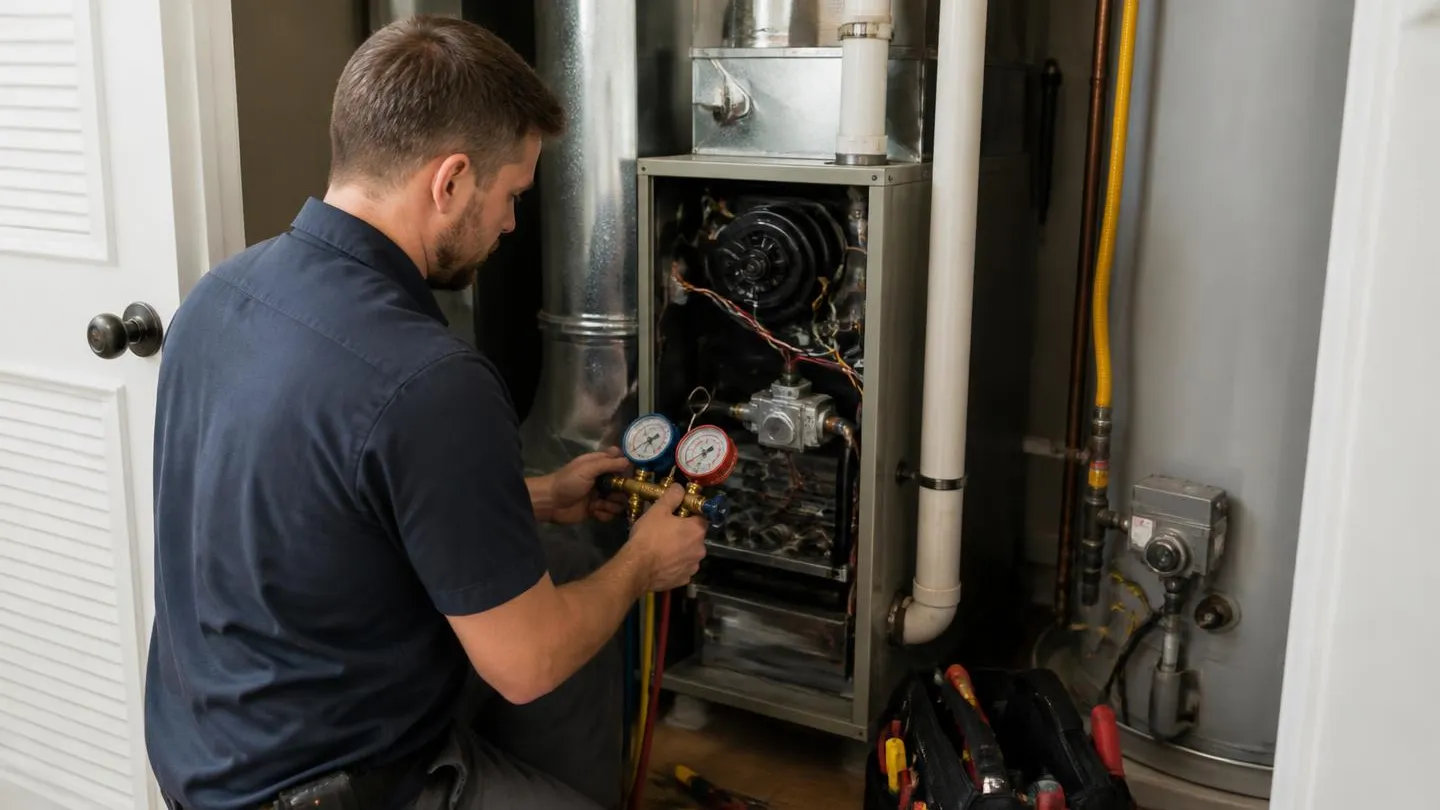
Repair usually wins when the system is within its expected service life, the failed part is not one of the expensive ones, and the system has otherwise been reliable. Replacement usually wins when the equipment is old, the failed component is the compressor or heat exchanger, refrigerant is leaking on an older system, or repairs have become a yearly event. Ask the technician for the age of the equipment, the specific failed part, and the cost of the repair against the cost of a new system before deciding.
Key points
- The age of the equipment and the identity of the failed part drive most of the decision.
- A cracked heat exchanger is a safety issue, not a budgeting question.
- Get the diagnosis in writing, including the model and serial number.
- Emergency conditions are the worst time to choose a new system, so ask about a temporary fix if one exists.
Start with three facts
With those three answers you can make the call without guessing. Without them you are negotiating in the dark, usually on a day when the house is uncomfortable.
- How old is the equipment, according to the serial number rather than the homeowner's memory?
- Which component failed, and is it a wear item or a major component?
- What is the repair quote against the quote for replacement equipment of similar capacity?
Repairs that are usually worth doing
- Capacitors, contactors and relays
- Igniters, flame sensors and thermocouples
- Blower motors on a system that is otherwise in good shape
- Thermostat and control faults
- Condensate drain and clog issues
Failures that usually point to replacement
If a technician recommends replacement for a safety reason such as a cracked heat exchanger, treat that as a stop rather than an upsell to negotiate. Ask to see the finding and get the documentation.
- Compressor failure on an aging air conditioner or heat pump
- A cracked heat exchanger in a furnace, which a technician should red-tag rather than patch
- Repeated refrigerant leaks, particularly on systems using older refrigerants that are being phased down
- A system that has needed a significant repair in each of the last few seasons
Want a second opinion or a replacement quote?
Find HVAC helpIf you are replacing, do not skip the sizing conversation
Equipment that is oversized short-cycles, cools unevenly and leaves humidity behind. A contractor should size the system from the house itself, using a load calculation that accounts for square footage, insulation, windows and orientation, rather than matching whatever number is on the old unit.
Ask what happens to the ductwork as well. New equipment on undersized or leaky ducts underperforms, and duct issues are easier to correct while the system is already open.
Common questions
- How long does a furnace or air conditioner usually last?
- Service life depends heavily on installation quality, maintenance and climate. Ask the technician what they typically see for your specific equipment in your area, and weigh that against the repair cost rather than a rule of thumb.
- Is it worth repairing an old system to get through one more season?
- Sometimes, and it is a reasonable request. Ask directly whether a temporary repair is safe and how long it should reasonably hold, then plan the replacement outside of an emergency.
- Should I replace the furnace and air conditioner at the same time?
- Contractors often suggest it because indoor and outdoor equipment are matched for efficiency and because the labor overlaps. It is a real consideration and also a bigger purchase, so ask what changes if you replace only the failed half.