
Tree maintenance for homeowners
What routine tree care involves, what homeowners can safely handle, and the warning signs that mean a professional should look at a tree soon.
By Elijah Canfield, Founder, Hire Best Pros · Updated August 26, 2026
Elijah Canfield is the founder of Hire Best Pros. He writes and edits the site's consumer guides, with a focus on how home service and moving projects are priced, scoped and compared.
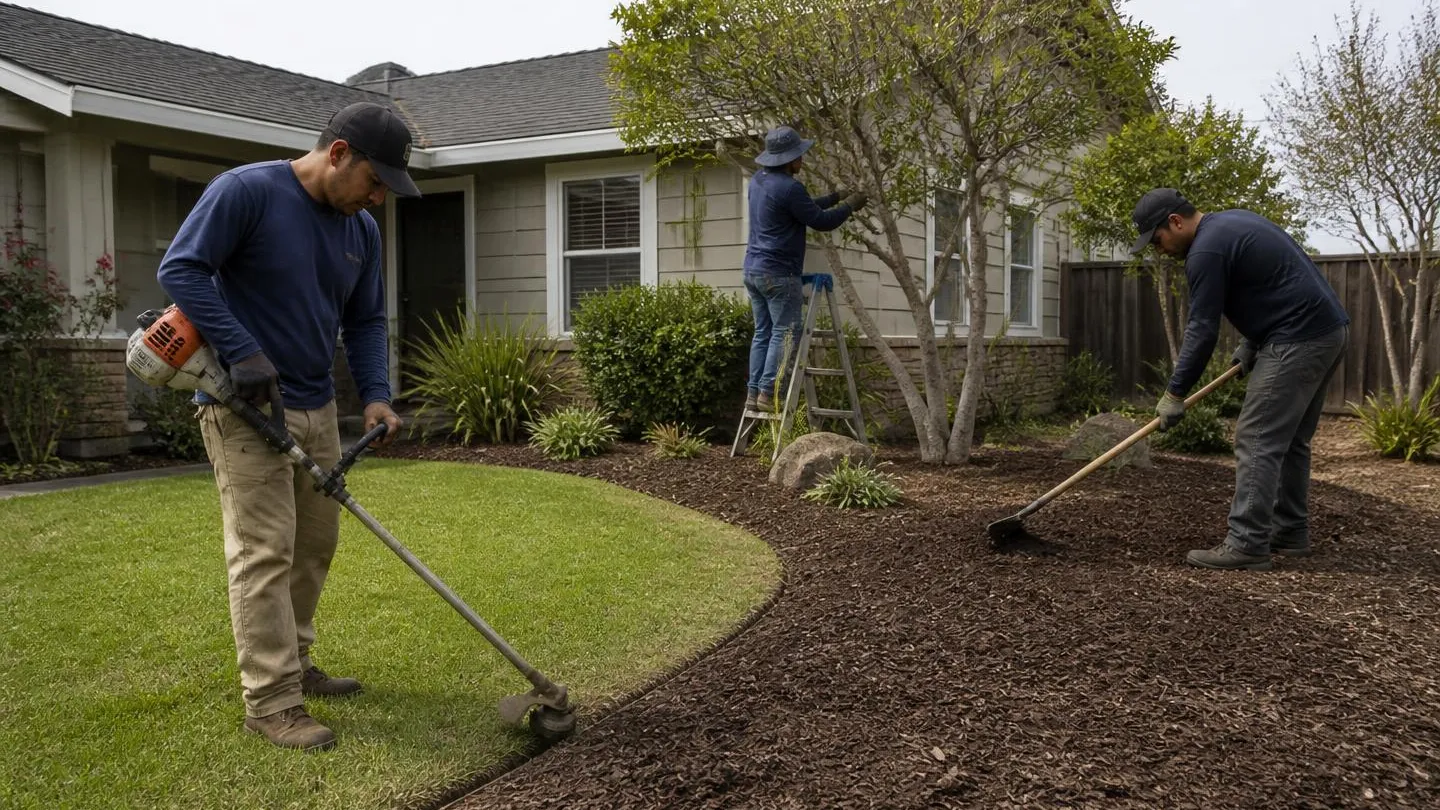
Routine tree care is mostly observation, watering while trees are young, mulching correctly, and pruning at the right time for the species. What homeowners should not take on is anything requiring a ladder or a chainsaw above shoulder height, anything near power lines, or any tree showing signs of structural failure. Those are professional jobs and, near lines, a utility matter.
Key points
- Mulch in a ring, never piled against the trunk.
- Pruning timing depends on the species and on why you are pruning.
- Any work near power lines is for the utility or a qualified line clearance crew.
Routine care
- Water deeply and less often, especially for young trees and during drought
- Mulch in a wide, shallow ring with a gap around the trunk
- Keep mowers and trimmers away from the trunk, since bark damage is permanent
- Remove stakes once a young tree is established
- Walk the property after storms and look up
Pruning
Prune to remove dead, damaged, crossing or hazardous limbs, and to keep clearance over paths, drives and the roof. Timing depends on species and purpose, and some trees are best pruned while dormant. Removing too much live canopy at once stresses a tree, so restraint matters more than tidiness.
Want a professional to handle the tree work?
Find landscaping helpWarning signs worth an inspection
- A sudden lean, or soil lifting on one side of the base
- Large dead limbs, or branches that have broken but not fallen
- Deep cracks in the trunk or a hollow sounding cavity
- Mushrooms or conks growing at the base or on the trunk
- Sparse leaves compared with previous seasons, or dieback at the crown
- Any limb growing into or near power lines
Leave these to professionals
- Any cutting that needs a ladder or work above shoulder height
- Removal of large limbs or whole trees
- Anything within reach of overhead lines, which belongs with the utility
- Trees close to the house, driveway or a neighbour's property
Common questions
- Who is responsible for a tree touching power lines?
- Contact your utility. Line clearance work requires qualified crews, and it is not homeowner or general landscaper work.
- Is topping a tree a good way to control size?
- Topping is widely discouraged by arborists because it stresses the tree and produces weak regrowth. Ask about structural pruning or, where size is genuinely wrong for the space, removal and replacement with a suitable species.
- How do I choose a tree service?
- Ask for proof of insurance including liability and worker coverage, ask who will actually be climbing or operating equipment, and ask for a written scope covering the work, debris removal and stump handling. Ask what they will do to protect the lawn, driveway and structures. Be cautious of door to door offers after a storm and of anyone requesting full payment up front.
- When is the right time to prune?
- Timing depends on the species and your climate, and the wrong window can stress a tree or invite disease. Dead, damaged or hazardous limbs can be removed whenever they are found. For shaping and larger cuts, ask an arborist what is appropriate for that specific tree in your region rather than following a general rule.